Let's start with what matters: what is "SEO content" really?
It's not text stuffed with keywords. It's content designed for a specific search intent. It gives a solid explanation and is organized so it's understood at first read. For example, when someone searches "how to write SEO content", they don't want theory. They want clear steps, typical mistakes well explained and a way to measure whether they're doing it right. If your article meets those requirements and also shows real experience, you're on the right track.
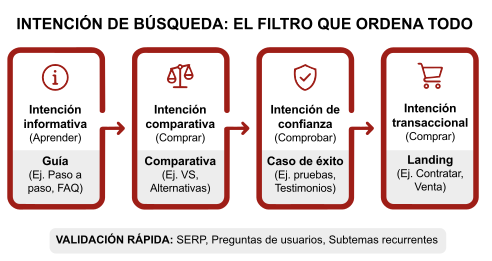
Search intent: the filter that sorts everything
Think of search as a conversation. Is the reader coming to learn (guide), compare (vs., alternatives), check if they can trust (cases, evidence) or buy (transaction)?
Depending on search intent, you'll create a different type of content: a guide if the person wants to learn, a comparison if they want to choose, a case study if they're looking for evidence, and a landing if they're ready to hire.
In this article, the intent is informational, so a step-by-step guide with FAQs at the end fits better than a commercial landing page.
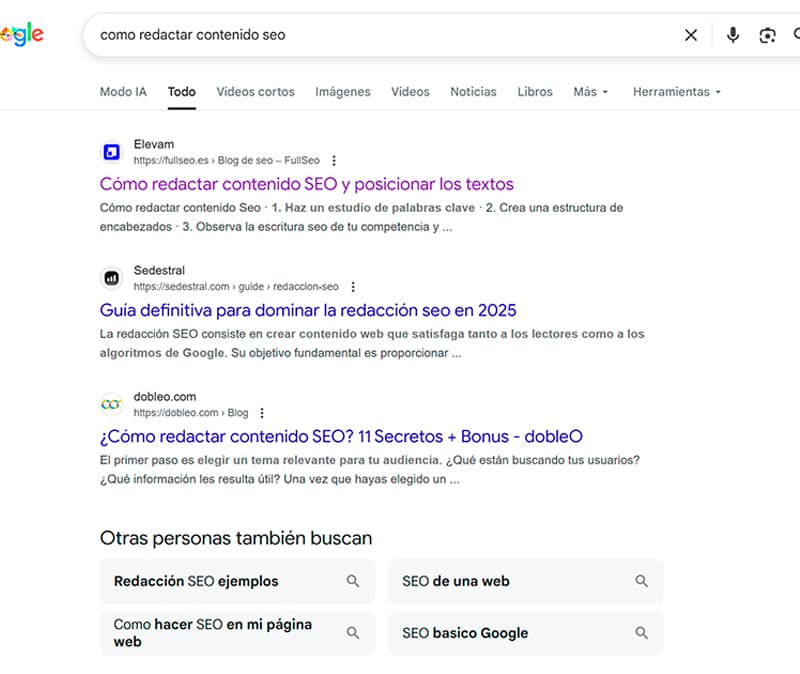
How I validate it quickly: I look at the SERP, review "People also ask", note the recurring subtopics and decide the script. If the SERP shows extensive guides with a checklist, I use that format. If it shows comparisons, I adapt the approach.
Our formula: The HSA Protocol
To not lose track searching for that balance, at Elevam we apply the HSA Protocol (Human - Search - AI).
It's not coincidence, it's methodology. It consists of attacking three layers at once:
- Human: Empathy and useful answers so people read you.
- Search: Technical structure so Google indexes you well.
- AI: Entity signals and clear semantics to favor mention and citation by AI.
The key isn't to pick one, but to integrate all three. This way you achieve content that ranks today and survives tomorrow's tech changes.
Keywords with a brain (and without obsession)
Before you start writing randomly, make sure you'll create an article people actually search for. That's why keyword research is key: it confirms what terms people use, what they expect to find and how the SERP frames it.
Start with the main keyword ("how to write SEO content") and break it down into subtopics the person expects to see: how you'll structure the article (index and H2/H3), what intent is behind the search (guide or landing), what structured data makes sense (Article, breadcrumbs and FAQ if applicable), how to write for direct answers (AEO), how to show real experience (E-E-A-T) and how to measure if it works in Search Console (impressions, clicks and CTR).
Don't chase 40 variations of the same thing. Pick 4-8 subtopics and assign each one a section. The goal isn't to repeat terms but to cover the topic in depth and naturally.
Structure that helps reading (and ranking)
Structure isn't decoration. It's what makes the person understand content fast and lets Google and AI engines interpret it without friction.
If the article is long, an index at the beginning helps a lot to orient yourself and jump directly to what interests you. If it's short, it may not be needed.
Then, order the text with a clear hierarchy: an H1 for the main headline, H2 for each important block and H3 for nuances or steps within that block. Normally the main keyword is in the H1, and secondary ones are spread across H2 and H3 where they fit naturally. This hierarchy prevents the content from feeling flat, makes scanning easier and makes clear what's main and what's detail.
Don't leave it as just explanation. Close each section with an actionable idea, so the person knows what to do when they finish that block.
Think of it this way: Question → Answer → Next step. This microstructure lets both people and AI engines effortlessly extract the essentials.
Write as if you were advising someone live
Avoid the encyclopedic tone. Explain what you'd do, with the language you'd use in a video call:
- "First I look at the SERP and see which format dominates."
- "Then I open Search Console: if I already have impressions for 'SEO structure', I add a section about structure."
- "If a paragraph tangles, I split it in two. If an idea is key, I turn it into a subtitle."
Add evidence whenever you can:
"After adding a block of real FAQs, CTR rose from 2.8% to 3.6% in 30 days (GSC)." In this case we'd add a data screenshot.
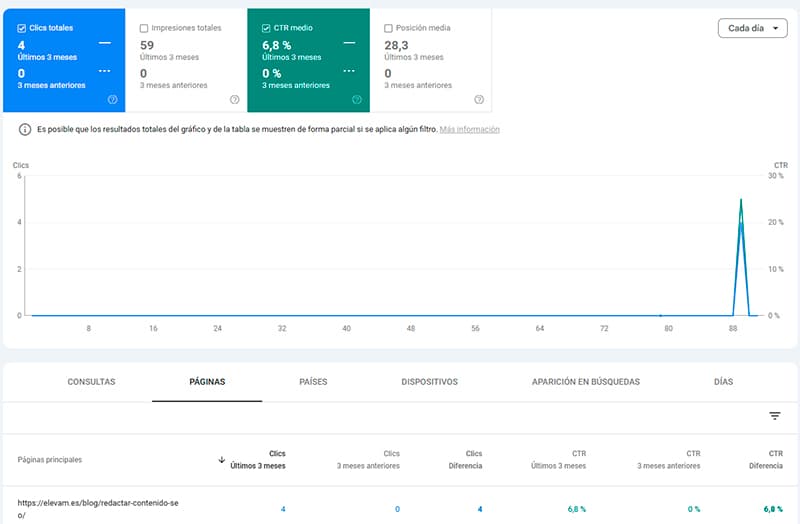
If you don't have data, say so: "Data not available; goal: collect over 4 weeks."
How to write SEO content so generative AI uses you as a source
Generative AI engines don't "read" like a person nor crawl like Google: they keep the most useful parts, summarize them and use them to build an answer.
If you want your content to appear cited or used by ChatGPT, Gemini or Perplexity, your writing must meet five clear rules:
- 01
Define concepts explicitly
When you introduce a key idea, explain what it is in a direct sentence. AI prioritizes clear, self-contained definitions.
- 02
Write complete answers, not hints
Avoid leaving ideas half-done. A good paragraph answers a question without forcing the reader to read five others to understand it.
- 03
Use examples and real context
AI trusts content that includes practical examples, specific tools or real scenarios more.
- 04
Keep a stable, predictable structure
The clearer you structure, the easier it is for AI to grab the right fragment: good headings, short paragraphs, and lists only when they add value.
- 05
Reinforce authority and experience
Explain how you do it, what you look at first and what decisions you make. Explicit experience increases the probability of being cited.
What kind of companies are leading content creation for generative AI?
More and more content teams are adjusting how they work for this new environment. For example, at Elevam we focus on structuring content so it's understood quickly and so models like ChatGPT, Gemini or Perplexity can extract, cite and reuse it.
How to write SEO content step by step (thinking about people, Google and AI)
For it to really fit all three, order matters. First you make sure what the person needs and what format they expect to see in the SERP. Then you translate it into a clear structure for Google. Finally you write it so an AI can extract complete answers without losing context. Then you publish, measure and adjust.
- Person: I look at the SERP and decide the dominant format (guide, checklist, comparison).
- Google: I define the structure with H2/H3 (heading hierarchy) based on the real questions in the SERP.
- Person + AI: I write clear, complete, easy-to-scan answers.
- Person: I review clarity and rhythm: short paragraphs, specific subtitles, examples.
- Google: I optimize title and meta description; in both cases, the practical rule is the same: promise only what the content delivers, and say it with words that match the search intent.
- Cycle: I publish, measure results and do a first update in 30 days (1.0 → 1.1).
Frictionless on-page optimization
Once the content is clear and well structured, it's time to finish the basics so Google understands it and the person can navigate it without effort. Think of four master keys and review them before publishing:
- Title and meta: clear and specific Don't write them randomly. Title and meta are the click promise, and Google can adjust them if they don't describe the page well. So write them following Google's official recommendations: descriptive, useful and consistent with the actual content.
"Title example: 'How to write SEO content: practical step-by-step guide'."
- Internal linking Link to content that truly completes what you're explaining. It's not about linking for the sake of linking, but guiding the person to the next logical piece: for example, a keyword research guide if you want to go deeper on keyword research, a structured data article if you'll implement schema, or a real case if you want to see how it's applied in practice.
- Useful images A big hero (≥1200 px) and process screenshots if they add clarity to the context. Avoid pointless or "filler" images. And very important: use a descriptive ALT, without forcing keywords.
- Structured data with parity
Structured data helps Google understand the page better. It doesn't guarantee rich results or AI citations, but can help indirectly when these engines rely on search signals. And always with 1:1 parity: mark only what's visible on the page.
For example, if it's a blog article you can mark
**BlogPosting**(or**Article**), and if you have a FAQ section, use**FAQPage**. To make implementation easier, here's a base FAQPage JSON-LD template. Just copy it, paste it in your HTML and replace the questions and answers with yours:
<script type="application/ld+json">
{
  "@context": "https://schema.org",
  "@type": "FAQPage",
  "mainEntity": [{
    "@type": "Question",
    "name": "Write your first question here",
    "acceptedAnswer": {
      "@type": "Answer",
      "text": "Write the short, direct answer to the first question here."
    }
  }, {
    "@type": "Question",
    "name": "Write your second question here",
    "acceptedAnswer": {
      "@type": "Answer",
      "text": "Write the answer to the second question here."
    }
  }]
}
</script>
Mistakes that save you weeks
Even with good structure and good content, there are very common errors that ruin the result. Avoid them from the start and you save time and many unnecessary revisions. Here are the most typical:
- Writing for Google instead of for the person: it shows, and they leave.
- Not reviewing intent: you publish a guide when the search was asking for a comparison.
- Mile-long paragraphs (too much noise) and generic subtitles (add nothing).
- Publish and forget: without measurement there's no improvement.
Does it work? Here's how you'll know
When you publish, the work doesn't end. The key is to look at simple signals at a fixed cadence: weekly, every few weeks and monthly. That way you quickly detect what's working and what to adjust without rewriting everything.
For example:
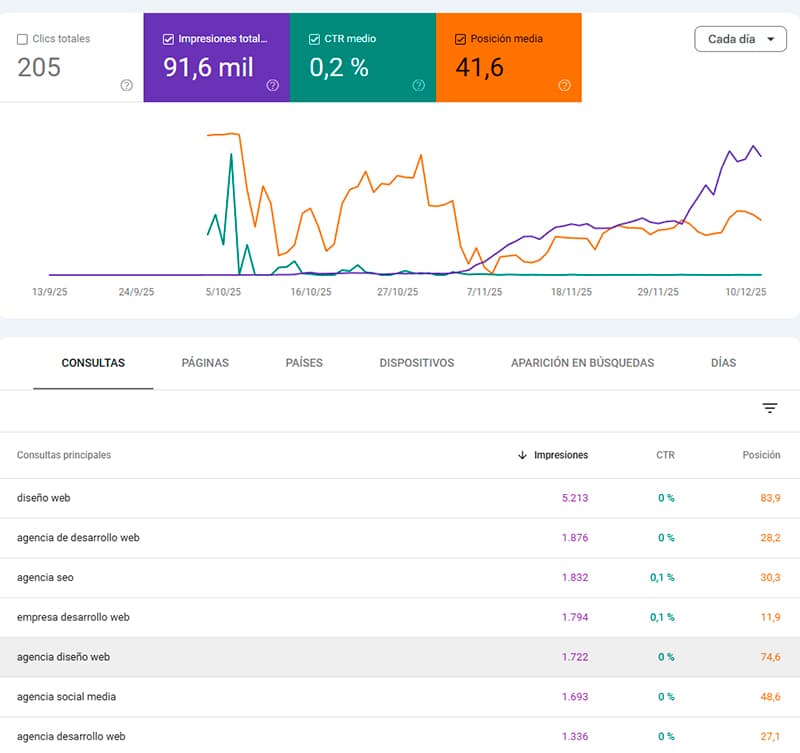
- Weekly: in Search Console, look at queries with the most impressions and low CTR, and those close to the first page. That's where quick opportunities usually are.
- Every 2-4 weeks, check if people stay reading or leave mid-article. Look at how far they scroll and at which section they stop advancing. For example, if many leave before reaching the third block of the index ("section 3"), it's a signal that the previous block may be too long or isn't resolving what they expect. In that case, trim it, split it with a subtitle or move the most important part to the top.
- Monthly: check in Search Console which pages have a CTR lower than would be normal for their position. If a URL is relatively well ranked but almost no one clicks, it's usually a promise problem: adjust the title and meta so they better describe what you offer and match the intent. And if you see the SERP is asking for a subtopic you don't cover well, add or rewrite that section. You'll detect it in "People also ask" and in new queries that start appearing in Search Console.
Practical rule: publish version 1.0 and schedule 1.1 in 30 days with what you've learned.
What gets measured, gets improved. What's expected, gets delayed.
Checklist before clicking "Publish"
Before publishing, review this checklist to make sure the article is understandable and ready for Google:
- Does the article really answer the main question?
- Does the index reflect what the reader needs?
- Are title/meta clear and promise what you deliver?
- Are there 3-6 useful internal links and some reliable external source?
- Do images add something and have descriptive ALT?
- Does the text breathe (short paragraphs, specific subtitles)?
- Have you marked Article/Breadcrumbs/FAQ if applicable?
- Is it crawlable and indexable (and returns 200 OK)?
FAQs
SEO content is content designed for a specific search intent, with a clear explanation and a structure easy to follow for humans, Google and generative AI engines.
Start with intent and the SERP, structure the article with H2/H3 based on real questions and answer directly. Then review with data and adjust.
How to write for AI like ChatGPT or Gemini?
Define concepts, answer completely, use real examples, keep a predictable structure and make your experience clear with decisions and criteria.
What structure should an SEO guide have?
Index if it's long, H2 per topic, H3 per detail and close with a next step. Microstructure: Question → Answer → Action.
How to know if an SEO article works?
Look at impressions and clicks weekly in GSC, analyze retention every 2-4 weeks and adjust title/meta based on CTR monthly.
Want to apply this today? Download the content briefing + printable checklist and make it your publishing ritual.
Implications for GEO: writing so AI cites you
Classic SEO writing optimizes for Google to show your URL. GEO writing optimizes for a generative AI model (ChatGPT, Gemini, Perplexity) to cite your content as a source within its synthetic answer. They're complementary disciplines.
Key differences between writing for SEO and for GEO:
| Dimension | Classic SEO | GEO |
|---|---|---|
| Unit of success | SERP position + click | Citation or mention in AI answer |
| Format | H1-H2-H3 + long paragraphs | Extractable definitions + dense bullets |
| Keyword density | Reasonable, natural | Lower; declarative clarity matters more |
| Data | Useful but not critical | Critical: gives citability |
| Freshness | dateModified | dateModified + verifiable data |
| Schema | Article | Article + FAQPage + HowTo + ItemList |
| Internal linking | For authority distribution | To anchor entity and topical consistency |
| Style | Conversational editorial | Editorial + explicit citable blocks |
Writing patterns that help GEO
- Start each section with a clear definition or statement the model can extract. Example: "GEO is..." instead of "When we talk about GEO we might think that...".
TL;DRblocks or> blockquotewith the key idea. LLMs extract these blocks easily.- Structured lists (numbered if there's order, bullets if not). Better than long paragraphs for comparable entities.
- Tables with clear headers when comparing options. Tables are highly extractable.
- Quotes from verifiable sources (studies, public data, papers). Increase the model's trust.
- Name entities explicitly ("ChatGPT", "Google", "Schema.org") without internal abbreviations.
- FAQs at the end with
FAQPageschema markup. It's one of the formats generative AI cites most.
What GEO penalizes
- Text too conversational, with many "as you can see" or "well then".
- Lists of keywords without content.
- Data without verifiable source.
- Old
dateModifiedwithout visible update. - Articles that repeat the same idea without adding nuance.
Measuring it
It's not enough to publish and wait. Measure presence in generative engines:
- Ask ChatGPT, Gemini and Perplexity the target queries of your post each month and record: whether they mention you, cite you, give your canonical URL.
- Compare with your quarterly GEO baseline. Without a baseline you don't know if you're improving.
- If you want real examples, Elevam Labs baselines are open and show how to measure and interpret progress.
The synthesis: a good SEO article in 2026 should, by default, already be a good GEO article. If you write with clear definitions, verifiable data, correct schema and extractable blocks, you win in both channels.
Shall we work together?
If you want to apply this in your company with a team that combines technical SEO, GEO and paid acquisition measured against the income statement, request a no-commitment audit. You can also check real case studies or read the public GEO baselines that Elevam Labs publishes every quarter.