At Elevam we're aware of the importance a good linkbuilding strategy has to achieve success with a website and the fact is links are key when placing a website among the top positions of Google search results, and therefore, increasing the number of visits and conversion.
But in today's post we're not going to talk about how to design a careful and consistent backlink strategy; instead we're going to focus on poor-quality toxic backlinks, a technique increasingly on the rise in SEO ranking, specifically in Black Hat SEO or Negative SEO, that we shouldn't overlook.
You'll be interested in: What is, what's it for and what benefits will a linkbuilding campaign bring to your website?
We're going to tell you what backlinks are, what you must do to identify the poor-quality ones and how you can eliminate them, so if until now you didn't know what backlinks were or, you simply hadn't paid them the attention they deserve, we recommend you pay attention and take note; what we're going to tell you next is of interest to you.
What are backlinks?
When we talk about backlinks, we're referring to incoming links that arrive at our website from other pages. A priori, having backlinks pointing to our website is beneficial, since the more pages link to us, the more relevance and authority we'll get, and the easier it'll be for us to climb positions in Google.
But as we said, this is a priori, since it's true that as long as those incoming links arrive to us from pages considered relevant in Google's eyes, the result will be positive.
Things change when links arrive from poor-quality pages, considered SPAM or that have suffered some type of penalty. In that case we'd be receiving harmful backlinks, which represents a real risk, since if our number of poor-quality toxic backlinks is very high, we could end up being penalized, watching our website lose positions in Google at a dizzying pace.
And the bad consequences of receiving toxic incoming links are due to the Google Penguin algorithm, which is in charge of analyzing the suspicious links a website receives, penalizing the website itself for "bad practices" and causing a sharp drop in its organic traffic.
This, with the aim of damaging competitors' ranking, has become one of the main Negative SEO techniques currently, which means you have to be more attentive than ever to your link profile, to eliminate the harmful links that may be linking to you.
At Elevam, with the goal of helping you not suffer a Google Penguin penalty, we're going to give you a series of tips that will be of great help to you when identifying and eliminating poor-quality harmful links that are arriving from other websites considered toxic. Let's get started!
How to detect toxic backlinks?
Although there are different ways to identify harmful backlinks, we go with the Ahrefs tool, since we consider it the most complete and efficient. The only problem with Ahrefs is that it's paid, but in case you're not willing to pay for it, you have other options like "Open Link Profiler", a tool that although perhaps not as complete, will allow you to detect the toxic links that are linking to your website.
Both tools allow us to analyze the number of incoming links that reach our website. Normally, one of the most effective ways to identify them is to observe the quantity of incoming links that are pointing to our website.
In case the graphs show us that in a short period of time, we've received a very high quantity of links, higher than usual, it's very likely we've suffered a negative SEO attack, and Google will identify that these links have been generated artificially.
It could also happen that after a long period without reviewing our link profile, you check that you've received poor-quality links. Although these links are possibly not due to a negative SEO attack, it would be appropriate to eliminate them, since otherwise they could put our website's ranking at risk.
We show you a video of how Matt Cutts explains the "Disable links" function from the Search Console tool
How to eliminate poor-quality toxic backlinks?
Once we've detected the toxic backlinks our website is receiving, the time comes to put an end to them. To do so we have to access our Webmaster Tools, and through the Disavow Links Tool, which is the best known and most effective regarding link disavowal, we'll send a report to Google with all the links we don't want it to take into account, indicating they're low quality and we want to get rid of them.
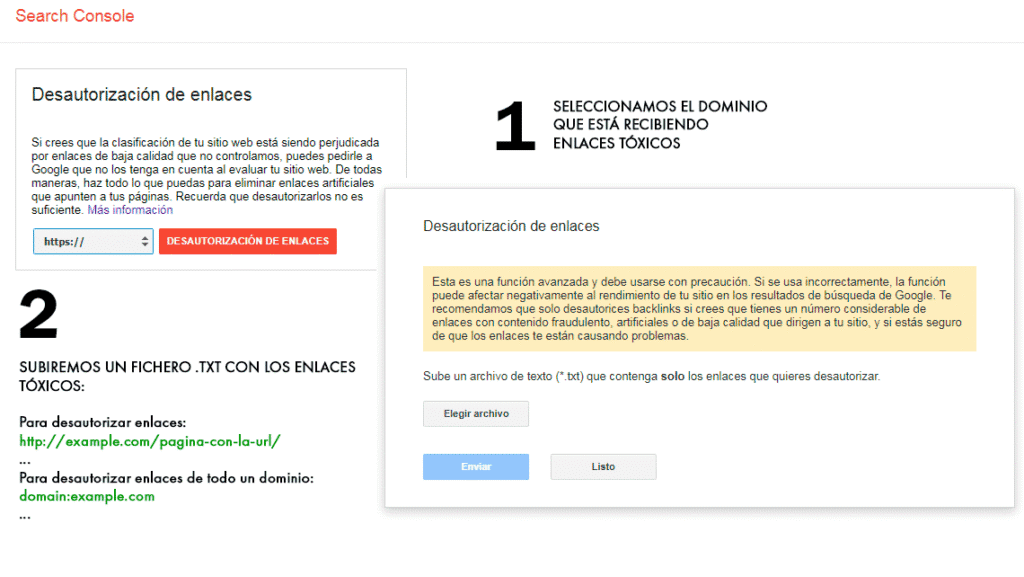
If you do this maintenance with a certain frequency (once a month at minimum), you'll ensure that when Google's bots crawl your website, they won't be able to detect any toxic URL, and therefore, you won't be able to be penalized by the Google Penguin algorithm, at least for having toxic links.
Conclusion
In short, having a good linkbuilding strategy is key to improving your website's ranking, but in addition to making the effort to receive quality incoming links from relevant sites, you must also pay special attention to your link profile, to check whether or not you've received toxic backlinks, and eliminate them if necessary.
Related reading
- How to index your website in Google
- Ranking in Google: technique, content and authority
- Best SEO agency: real criteria
Shall we work together?
If you want to apply this in your company with a team that combines technical SEO, GEO and paid acquisition measured against the income statement, request a no-commitment audit. You can also check real case studies or read the public GEO baselines that Elevam Labs publishes every quarter.