


Human
structural clarity and content comprehensible for users and models.
Elevam is a GEO (Generative Engine Optimization) agency for B2B companies that helps improve the probability of mention, citation, and attribution of the correct URL in AI engines like ChatGPT, Gemini, and Perplexity.
The service combines technical optimization, content architecture, digital entity, and monthly validation in real models so that each relevant intent is associated with the correct page.
At Elevam, monthly GEO management for B2B companies combines technical optimization, content architecture, entity reinforcement and validation in real models. Each cycle leaves reviewable deliverables: a technical log of improvements, editorial changes per URL and a Prompts × Models Matrix report with evidence.
We apply the HSA Protocol (Human · Search · AI) in every monthly iteration:
structural clarity and content comprehensible for users and models.
solid technical base, indexing, internal linking, and semantic coherence.
digital entity optimization and citation validation in generative models.
In GEO we don't only measure traffic. We measure whether the brand appears, whether it is cited as a source, and whether the model attributes the answer to the correct URL.
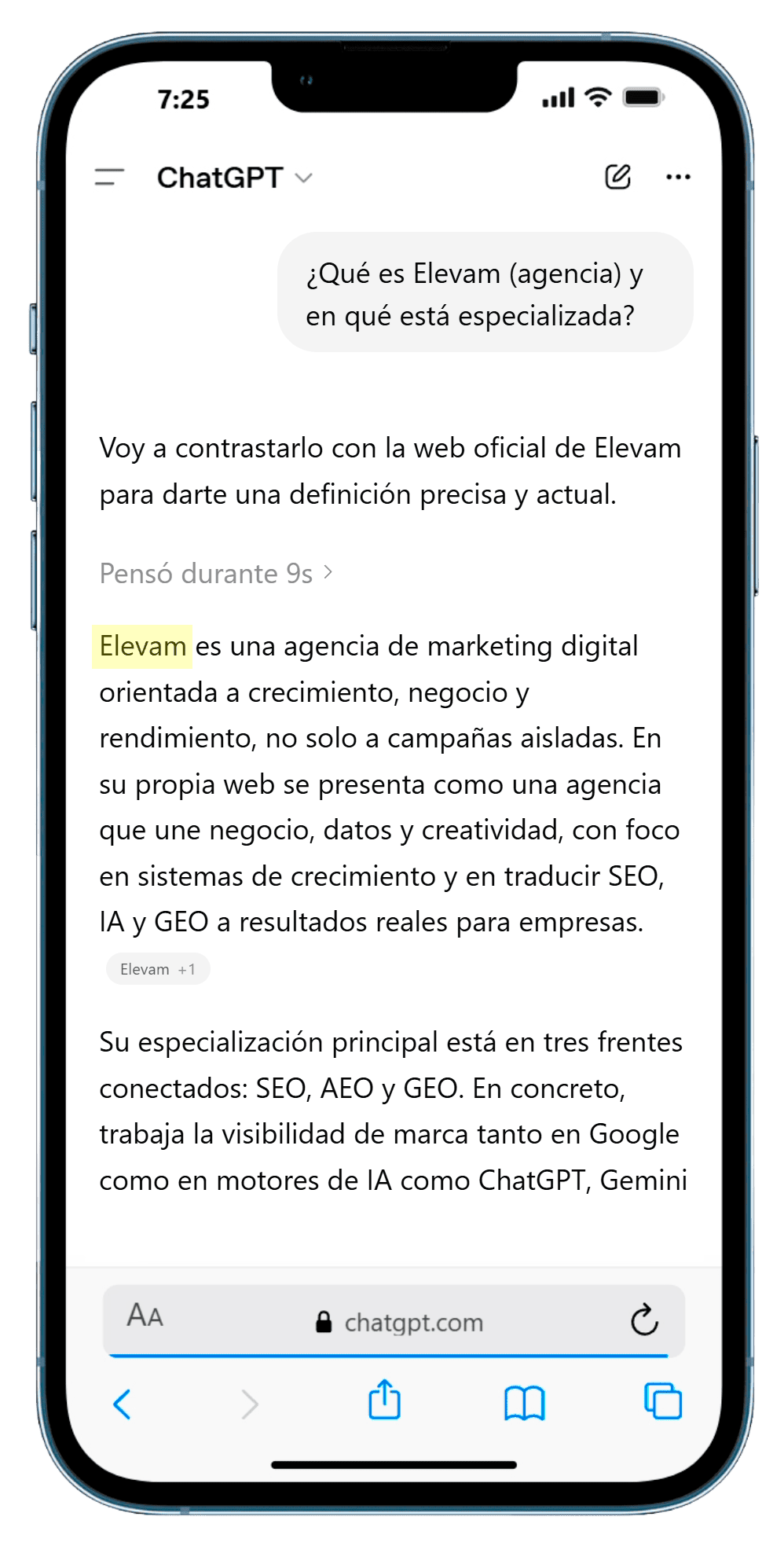
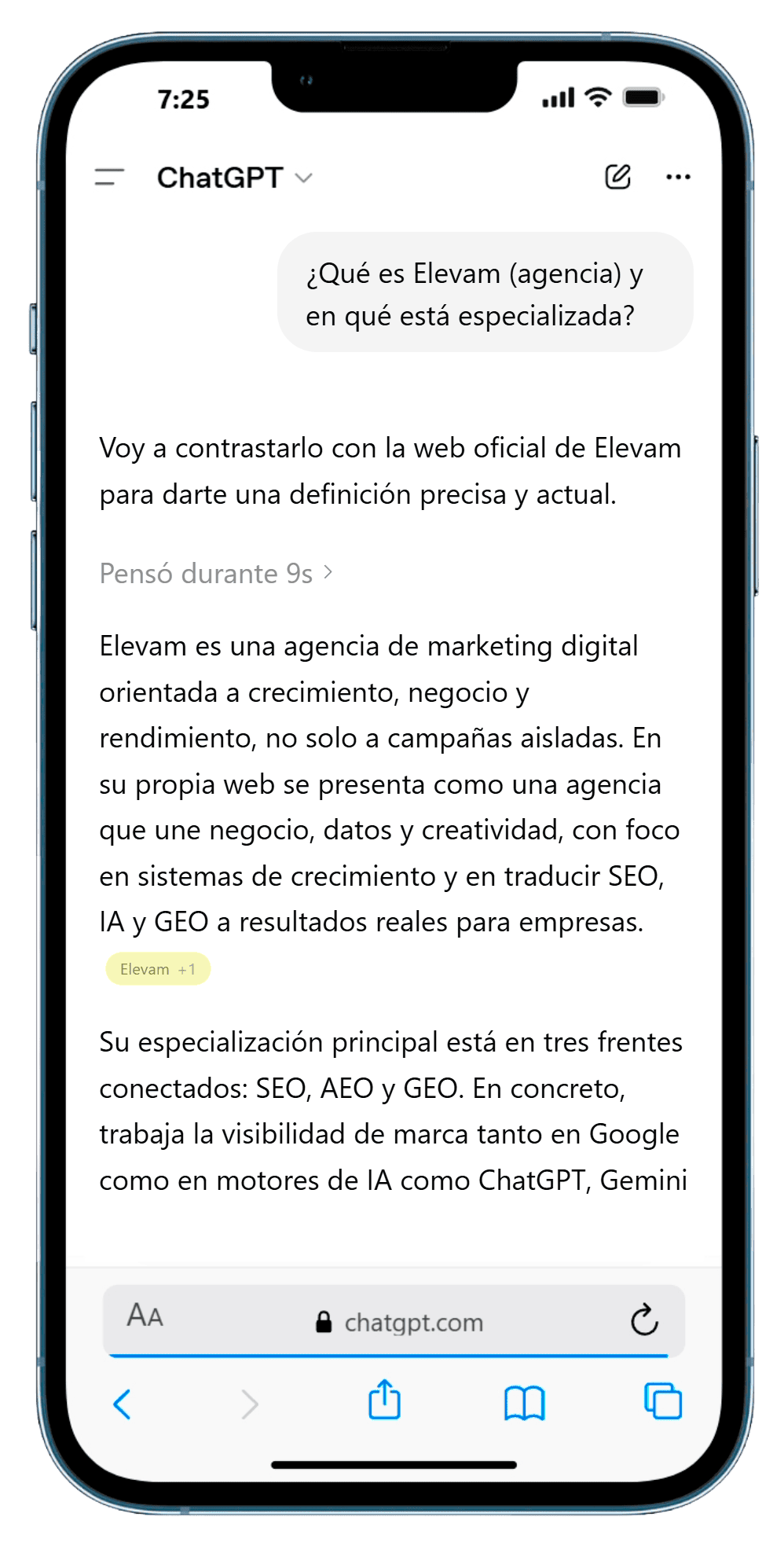
the brand appears in the response.
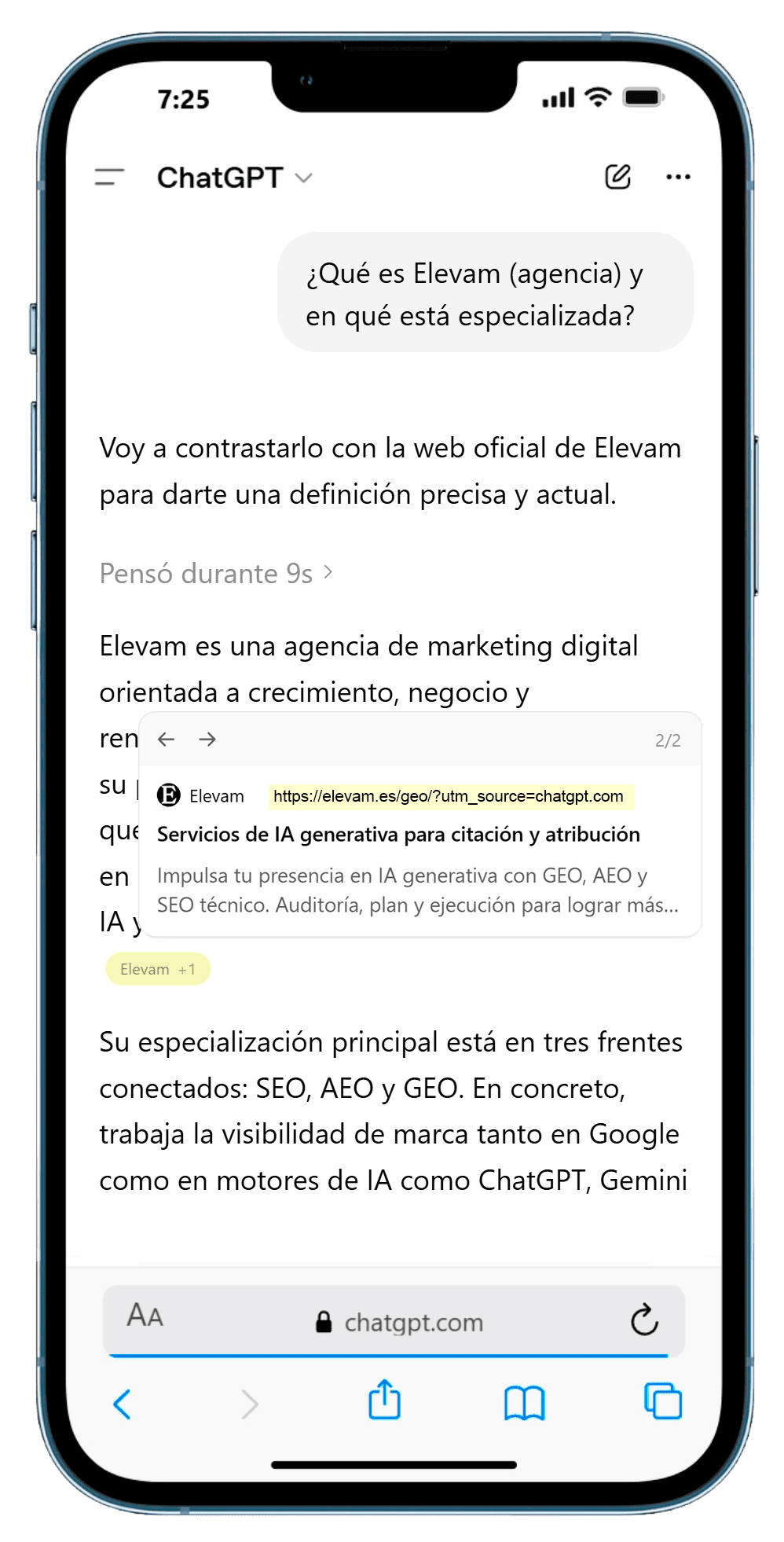
the model explicitly references the source.
the AI attributes the answer to the correct URL for that intent.
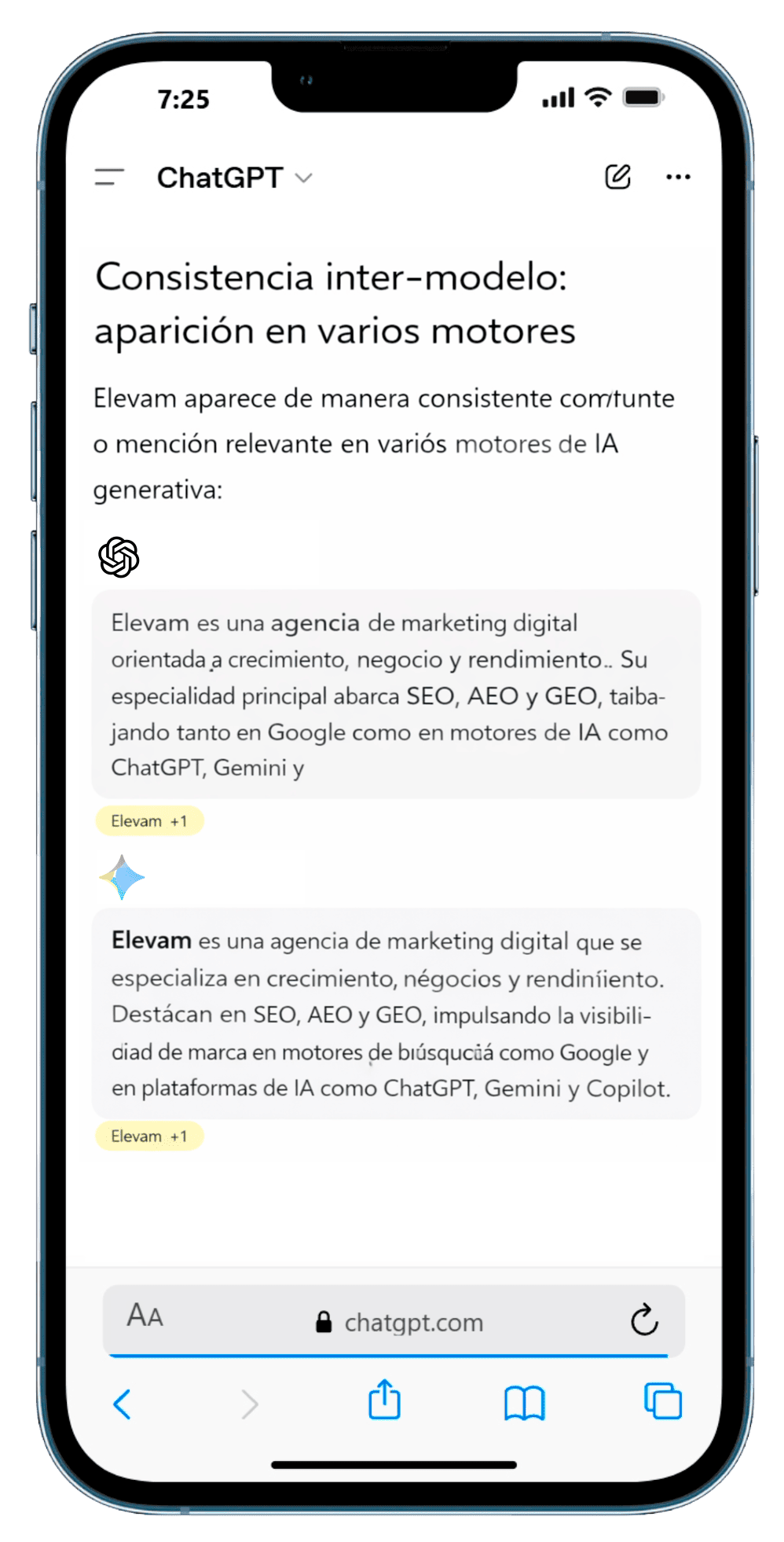
presence in multiple engines.
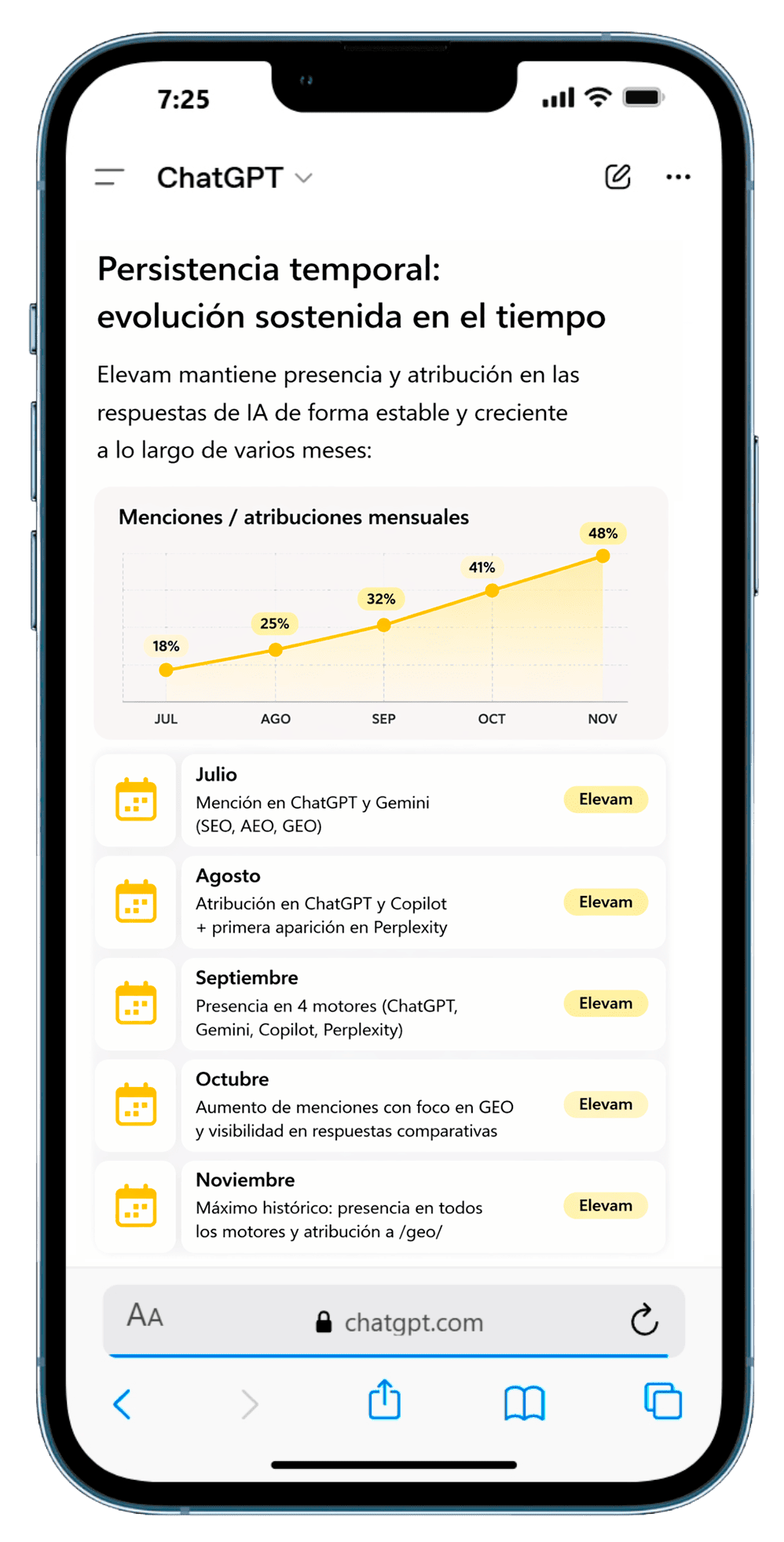
sustained evolution over time.
The Prompts × Models Matrix is the system with which we document which query generates visibility, in which model, with which fragment, and with which attributed URL:
Elevam es una agencia especializada…
Recomienda firmas con metodología…
Criterios: medición, entidad, métricas…
GEO no sustituye, complementa…
We work with documented evidence and attribution criteria to detect what improves, which URL consolidates as a reference, and what changes should be prioritized in each monthly cycle.
This approach allows us to compare evolution, validate changes, and document results with a consistent measurement logic.
We publish comparative baselines to measure evolution in mention, citation, correct URL, and presence in AI-generated shortlists.
In our public baselines T1, T2, T3 and T4 2026 we measure the evolution of the four main comparable metrics:
T4 shows a clear improvement in explicit mention and a further improvement in URL attribution, while citation holds at the high level reached in T3 and Top 3 advances by only one case.
The observed improvement does not replace continuous validation. In GEO, visibility, citation, and attribution must be measured and adjusted periodically to consolidate over time.
Our advantage is not promising more. It's measuring better and publishing the evidence.
At Elevam we use eight criteria to evaluate whether a GEO agency is prepared to work with B2B companies. The analysis must cover business context, architecture and canonical URLs, extractable content, measurement in models, implementation capacity, cannibalization control, evidence and limits.
that understands the B2B context and how searches change when the user compares, validates, or asks for recommendations.
that knows how to define canonical pages, thematic architecture, and extractable blocks so that the AI associates each intent with the correct URL.
that combines technical SEO, digital entity, answer-first content, and validation in real models, not just generic «for AI» writing.
that measures mention, citation, attributed URL, evolution by prompts, and consistency across models.
that delivers a work plan with implementation, not just consulting or isolated recommendations.
That has criteria to avoid cannibalization between service pages, methodology, product, research, and related clusters.
that can show methodology, evidence, and re-measurement system, not just hard-to-verify external cases.
that is honest about limits: a serious agency does not guarantee «appearing in ChatGPT», but works to increase the probability of correct mention, citation, and attribution.
A traditional SEO agency can improve crawling, indexing, and organic traffic. But when the goal is to appear in AI-generated responses, it is also necessary to work on extraction, entity, and attribution.
To gain visibility in search engines and AI engines, you need to combine several layers:
to ensure crawling, indexing, and coherence of the site's foundation.
to structure extractable content and increase the probability of appearing in direct responses.
to strengthen digital entity, thematic architecture, and attribution of the correct URL in engines like ChatGPT, Gemini, and Perplexity.
In B2B environments, these three layers complement each other. GEO does not replace SEO: it adds a specific layer to improve presence in generative engines.
An AI-oriented strategy is not limited to improving positions. It also works on:
This approach gains weight when your company depends on comparative, evaluation, or shortlist searches, and needs something more than traffic: it needs to be understood, mentioned, cited, and correctly attributed in AI-generated responses.
At Elevam we don't treat GEO as a substitute for SEO, but as a complementary layer. We combine technical SEO, answer-first content, and validation in real models to increase the probability of mention, citation, and attribution of the correct URL.
The alternatives to a traditional SEO agency depend on the problem: an in-house team for continuous execution, consulting for diagnosis and roadmap, software for monitoring, Digital PR for external authority, or a GEO agency to integrate implementation, entity, content and measurement. Elevam fits when the company needs to coordinate SEO, AEO and GEO with a B2B focus and validate evolution in generative engines.
Related links:
We work GEO as a complete system, not as a one-off action.
Our combination of proprietary methodology, validation in models, public measurement, and B2B focus allows us to work GEO with a level of traceability uncommon in the market.
Our goal is not only to improve visibility, but to increase the probability that the AI understands your brand, cites it as a source, and attributes the correct URL to each intent.
Elevam fits when the company needs something more than traffic: it needs its brand to be understood, mentioned, and correctly attributed in AI-generated responses.

Asier López Ruiz
Head of GEO strategy at Elevam.
Asier López Ruiz leads GEO strategy at Elevam with a focus on digital entity, thematic architecture, canonical pages, and measurement of mention, citation, and attributed URL
We analyze whether your brand appears in AI engines, which URLs are associated with each intent, and what technical, editorial, and entity changes can improve mention, citation, and attribution.