If you want to do a keyword research that actually works in 2026, forget "Excel-style" keyword research: looking for volume, picking a main keyword and stuffing it into a page. Today that can give you traffic… and still attract bad leads, cannibalize URLs or lose the decision when the buyer compares with AI.
A modern keyword research is not about "stuffing keywords". It's about three things: intent (what the user wants to achieve), SERP (which format Google rewards for that intent) and architecture (which URL must answer it without mixing it with others).
If you prefer it on video (theory + practice), here are the two key pieces:
Theory part: https://www.youtube.com/watch?v=9xB_7vVJh1Q
Practice part: https://www.youtube.com/watch?v=38ceapTbp1g
Now, let's get to the post.
What is a keyword in SEO?
A keyword is the visible way in which someone expresses a need in a search engine. The important nuance is that in 2026 that need is expressed in two "languages".
In Google, standard search still exists: "SEO agency", "SEO audit", "CRM for real estate". In AI, the user no longer searches; they describe a scenario: budget, company size, restrictions, preferences, urgency. It's the same problem, expressed with context.
So, if your keyword definition stays at "word with volume", your strategy stays in 2015.
What is search intent and why does it rule a keyword research study?
Search intent is what the user is trying to achieve, not what they literally type. And here the most profitable rule of SEO still applies:
A URL must have one main intent. You can cover variations within that intent, but when you mix different intents on the same page, you usually break ranking and conversion.
If you're going to do a high-level keyword research, the first output isn't a list of keywords. It's a map of intents.
Real example: how we apply it at Elevam (1 intent = 1 URL)
At Elevam we follow this rule strictly. A transactional intent (hiring) lives in a service landing. A consultative intent (diagnosis/strategy) lives in another. And a training intent (learning) lives in another.
That's why GEO (service) has its own URL: https://elevam.es/geo/. The AI/GEO consultancy has its own: https://elevam.es/ia-geo/. And the course lives separately because it's another intent: https://elevam.es/curso-de-geo/.
Why is this important? Because if you mix "hire service", "I want consultancy" and "I want to train" into a single URL, the page becomes ambiguous. If you separate them, each page does its job: one converts, another qualifies, another trains.
What types of keywords exist?
Before getting into "head/middle/long tail", there's something very few people do that changes the profitability of a keyword: look at the SERP and ask whether, even when ranking, you'll receive a click.
Google doesn't just order links. Google tests formats. For the same search it might show ads, shopping, videos, images, maps, news, snippets… and keeps what the user uses. That "mix" can sink your CTR without you doing anything wrong.
Types of keywords by length (head, middle, long tail)
Length isn't a KPI, but it helps you understand two things: intent clarity and competition. In general, the longer the query, the clearer the intent usually is and the less "circus" there is in the SERP.
| Type | How it usually is | What happens in SERP | Advantage | Risk | Example |
|---|---|---|---|---|---|
| Head tail | Very generic | Google shows everything (and tests formats) | High volume | Low organic CTR and a lot of competition | "blanket", "CRM" |
| Middle tail | 2-3 words | Less noise, more defined intent | Good traffic/clarity balance | High competition if commercial | "CRM for SMEs", "SEO agency Reus" |
| Long tail | 4+ words or question | More "direct" SERP to the goal | High intent (decision) | Low volume (but tends to convert) | "best CRM for fintech with compliance" |
In B2B and in comparison markets, contextual long tails tend to be worth more than the "glamorous" head tails.
What modules can Google show in the SERP (and why they steal your click)?
The original post said it well: for head tail, Google tests more. For long tail, intent is clearer and there are usually fewer distractions. These are typical modules you can run into:
| Module/Section | When it appears most | Typical effect | What you should decide |
|---|---|---|---|
| Local Pack (map) | Queries with local or "nearby" intent | Diverts click to map and listings | If there's local intent, you need local landings and Google Business Profile |
| Shopping | Transactional product queries | Reduces organic CTR for ecommerce | If you sell product, define strategy (SEO + feed) or avoid that SERP |
| Ads | Commercial | Push organic down | Consider long tail / comparisons / different intent |
| Videos | Audiovisual intent | Capture the click | If video dominates, don't fight with text only |
| Images | Products/visuals | Divert attention | Optimize images or change goal |
| News | Topical | Classic organic loses space | If you're not media, avoid competing on "freshness" |
| Featured snippet | Questions and definitions | Can solve without click (zero-click) | Either you win it, or you choose another intent |
Types of keywords by intent
This classification is still the basis to decide what kind of page you need.
| Intent | What the user wants | Examples | Type of URL that usually works |
|---|---|---|---|
| Informational | Learn/understand | "how to do keyword research", "types of keywords" | Guide/article |
| Transactional | Buy/hire | "buy cheap blankets", "hire SEO audit" | Landing/category/product |
| Navigational | Reach a brand | "Elevam", "Apple", "Nike" | Home/brand page |
| Local | Find nearby | "SEO agency Barcelona", "veterinary clinic Madrid" | Local landing + listing |
| Comparative | Decide between options | "X vs Y", "best software for…" | Comparison with criteria |
How to know if a keyword is worth it? Look at the SERP before volume
Before falling in love with a keyword, look at what Google is showing. The SERP tells you what format the search engine wants and how many "click thieves" are above organic.
Simple but perfect example: if someone searches "blanket", Google doesn't know what they want. It shows videos, images, stores, articles. If someone searches "buy cheap blankets", the intent is already transactional and the SERP narrows: ecommerce, categories, Shopping. Same base word, different intent, different SERP, different profitability.
| What you see in SERP | What it means | What I would do |
|---|---|---|
| Lots of ads / Shopping / modules | Organic CTR drops | Attack long tail, comparisons or change approach |
| Videos dominating | Audiovisual intent | Video or don't fight that SERP blindly |
| Forums (Reddit/Quora) at top | Experiential intent | Content with experience + criteria |
| Strong featured snippet | Solved without click | Write for snippet or pick another intent |
| Rankings/comparisons dominating | Decisional intent | Honest comparison with criteria |
How to do a keyword research step by step (that turns into architecture)
A serious keyword research should always end in three outputs: map of intents, URL architecture and value prioritization. To get there, order matters.
What do you sell, to whom and whom do you NOT want to attract?
Before opening tools, define offer, segment and exclusion. If you don't set limits, keyword research will bring you generic traffic and junk leads.
Which intents deserve their own URL?
This is the most important decision. Ask yourself: is this intent different enough that the user expects a different page? If the answer is yes, it deserves its own URL. If not, it's a variation within the same URL.
What language does the market use when asking (and what language do you use)?
This is the typical hole: your website speaks like you. The market searches like the market. Collect sales questions, recurring objections and typical comparisons ("alternatives to…", "X vs Y"). That's real keyword research, not theory.
What do tools tell you and what does the SERP tell you?
Now yes: tools to expand variants, questions, long tails and PAA. But final validation is done by the SERP: dominant format, modules, real competition and type of result.
How do you assign keywords to URL without cannibalizing?
Unify variants within an intent and avoid duplicating two URLs for the same. If you have two pages that could answer the same intent, that's not "more SEO". It's cannibalization.
How do you prioritize by value, not by volume?
Prioritize by intent (close to decision), SERP (real available CTR), competition (viability) and value per lead (ticket and margin). Volume is a data point; it's not the KPI.
A keyword with 200 searches can be worth more than one with 10,000 if it attracts decision-makers.
Simple mental formula: Value = (Purchase intent) × (Lead's ability to pay) × (Probability of winning the SERP).
Volume isn't in the equation.
Silo-type SEO architecture: how to turn keyword research into a URL map
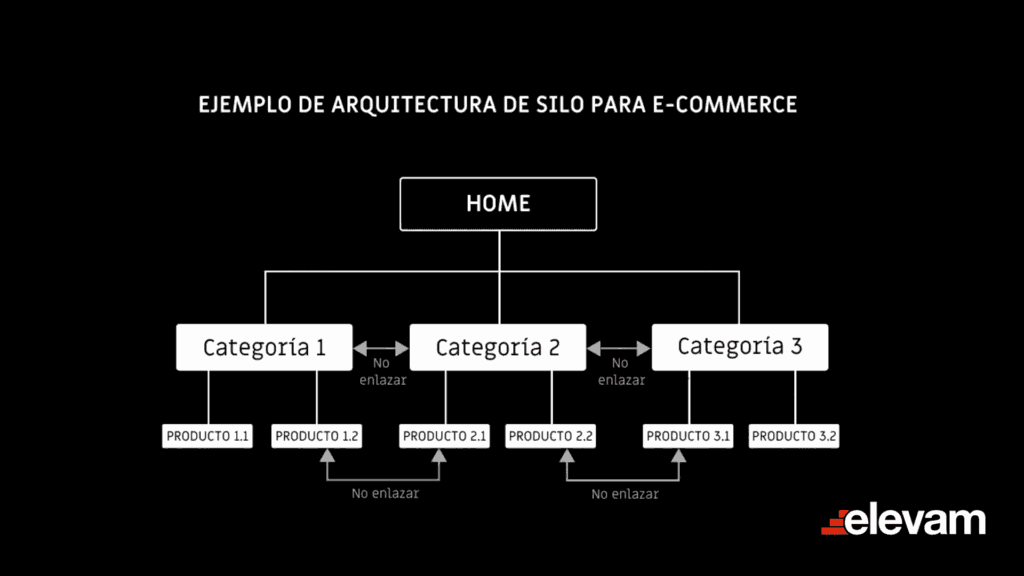
Keyword research directly affects architecture. The clearest way to translate it is a silo architecture: you group related intents under a pillar, and support it with subpages that go deeper and link to that pillar.
Visual example (simplified):
/ (Home) /services/ (Pillar) /services/geo/ (Main service) /services/ai-geo/ (Consultancy) /resources/geo/ (Editorial HUB) /resources/geo/guide-1/ /resources/geo/guide-2/ /resources/geo/comparisons/
Why does this work? Because Google understands hierarchy and intent. And so does the user. Also, in generative environments, a well-structured silo makes your content easier to retrieve by sections and easier to cite.
How does keyword research affect your website?
Keyword research isn't "what words do I put on the page". It's what pages exist to answer intents, and how you distribute authority and clarity so they win.
| What keyword research decides | Which error it avoids | What it means in practice |
|---|---|---|
| Architecture (URLs) | Cannibalization | One main intent per URL |
| Content (what you say and how) | Useless traffic | Buyer language + decision criteria |
| Interlinking | Poorly distributed authority | You reinforce pillars and guide the user |
| Anchors | Over-optimization | Natural variants, not repeat exact |
| Linkbuilding (if applicable) | Links to wrong URLs | You reinforce the URL that should win that intent |
Anchors and variants: the nuance the original post got right
A keyword research study also defines how you link. If you always link with the exact anchor, you're not building semantics, you're making noise. The smart thing is to use natural variants that represent the same intent.
Example: instead of always linking with "GEO agency", you can also link with "appear in AI answers", "ranking in generative AI", "optimization for generative engines", as long as you're pointing to the same intent and to the canonical URL.
How to do keyword research for clients without getting lost?
With clients, the typical mistake is they describe the ideal business, not the real business. For the keyword research to work, you need inputs almost nobody asks for: average ticket, margin per service, sales cycle, desired and excluded sectors, real objections and barriers (compliance, integrations, deadlines).
Then you do research by business categories, not loose ideas. And you validate it with reality: Search Console, Analytics, CRM and calls. A keyword research that doesn't touch real business is a pretty document nobody uses.
How to do keyword research for YouTube?
YouTube is another engine, with another SERP and another dominant intent. Keyword research for YouTube must take format into account: tutorial, review, comparison, "top", real case. If on Google an article wins, on YouTube a 7-minute video with demo and comparison might win.
The question you should ask yourself isn't "which keyword has volume", but "what format does the user expect" and "which videos are winning for that intent".
What changes when AI comes in and the buyer asks with context?
Here's the point almost no keyword research post explains well: the buyer no longer asks only with keywords. They ask with context. And that context generates shortlists.
At Elevam we sort this out with a simple framework: HSA (Human-Search-AI). Human: how a decision-maker asks when comparing. Search: how that translates into intents and SERPs. AI: how that decision appears in prompts and recommendations.
If you want to implement it as a system, you have two paths: execution as a service at https://elevam.es/geo/ or training to operate it with your team at https://elevam.es/curso-de-geo/.
Mistakes that still kill keyword research in 2026
If many websites "do SEO" and don't take off, it's usually because of this:
- Choosing keywords by volume without looking at the SERP.
- Mixing intents in a single URL.
- Creating informational content that doesn't connect with comparisons and decision.
- Ignoring the real language of the buyer (and speaking "internally").
- Not defining which leads you DON'T want to attract.
- Measuring success only with traffic when part of the decision happens without click.
Frequently asked questions about how to do a keyword research study
How to know which keywords to use?
Start with intent, not volume. Choose keywords that represent real decisions and validate the SERP before committing.
What is keyword research in 2026?
Mapping intent → SERP → architecture → content, and adding a context layer for shortlists in AI.
Which planner tool do we use at Elevam?
We use several depending on the case. The tool doesn't decide the strategy. Criteria does: intent, SERP, value per lead and architecture.
Does this cannibalize my service page?
Only if you do it wrong. Service captures transactional intent. Blog captures informational and comparative intent and redirects to the service when appropriate. If both compete for the same intent, the problem is the map, not the blog.
The last useful idea before you close this tab
If your keyword research study doesn't end in architecture and priorities, it's not a keyword research: it's a list. The goal isn't to "have keywords". The goal is for each intent to have a clear URL, with a format the SERP rewards and a language the buyer uses.
If you want us to set it up with you as a system (map of intents + architecture + editorial plan + query set with context), the most profitable thing usually is consultancy first: https://elevam.es/ia-geo/. If you already have clarity and want execution: https://elevam.es/geo/.
Editorial note: Why have we published this?
Because we keep seeing the same pattern of error: keyword research based on volume and "stuffing keywords", without looking at SERP, without separating intents and without thinking about the type of lead you're attracting. That approach produces generic content, websites with mixed intents and leads that aren't worth it. In 2026 the user compares more, asks with context and decides in shortlists before the click. If your keyword research doesn't incorporate real SERP, decisional intent and the language a buyer uses when about to decide, you'll rank things… and still lose the purchase. This article sets criteria: keyword research is still the basis, but volume alone is no longer enough.
Related reading
- How to expose data to AI with schema, feeds and entity
- Why AI doesn't recommend the same to everyone
- Elevam Labs public GEO baselines
Shall we work together?
If you want to apply this in your company with a team that combines technical SEO, GEO and paid acquisition measured against the income statement, request a no-commitment audit. You can also check real case studies or read the public GEO baselines that Elevam Labs publishes every quarter.