Internal links refer to those links or hyperlinks we manually apply on our website, directed to other internal pages of our own website.
In today's post we'll address a topic that is fundamental when applying SEO to one of our projects and achieving the expected results: internal linking. You've possibly heard of it and may have already applied it, but are you doing it correctly?
With this post you'll clear up doubts, since we'll give you a series of key tips when carrying out the definitive internal linking of your project, with which you'll get surprising results that will make a difference and you'll gain positions on Google. Interested? Then you know it, grab paper and pen and take note; let's begin!
What is internal linking?
Many people claim that to get good results at the SEO level with your project, it's fundamental to get a large number of external links. From here we're not saying this is wrong, since in fact external links can represent between 20% and 30% of SEO ranking, but we do want to highlight that just as important or even more is the internal linking technique, also known as interlinking.
A key technique that offers very positive results regarding the Internet positioning of our project, as long as it's done correctly, since otherwise it could even penalize us.
And internal linking doesn't consist of linking categories to each other without any sense, but requires good planning, logical methodology and above all, a lot of common sense.
What does this mean? It means the internal linking strategy must revolve around a main objective, drawing a network of links between different content within the same domain, with the main goal of facilitating Google's work. If we achieve this, we'll undoubtedly improve our website's ranking.
And why is internal linking so effective for SEO? Well basically because it's the most effective technique to facilitate Google bots finding new content published on our own website, which facilitates crawling, indexing and also ranking.
And in addition to this, internal links also improve user experience, bounce rate, transfer authority to different pages of the website and allow us to use the anchor text we want in each case.
Tips for doing your website's internal linking
Each teacher has their book, and the same happens with internal linking. There isn't a single strategy when applying internal links on your website, but there are a series of key tips that will be of great help when doing the interlinking of any type of website or project. Tips we'll explain below, and that will serve as a base when planning your strategy.
Where will you place the internal links?
It's important that before placing the internal links, you have it clear where you'll include them. The most recommended is that they appear at the top of the website, the higher the better, since this way Google will understand that this content has a higher value, and therefore will rank better.
In addition, if you're very interested in ranking a specific content, a good option is to link to it through the HOME, since it's the page with the most strength on a website and the most valued by Google.
Don't abuse
Internal links can be very beneficial when ranking your website, but always in their proper measure, since if you abuse them it's very likely you won't get the expected results.
Keep in mind that the larger the number of internal links on your website, the lower the value of each link and therefore, it will have more difficulties when ranking.
That's why it's important to distribute interlinking logically and always with the goal of achieving specific results.
Three-click structure
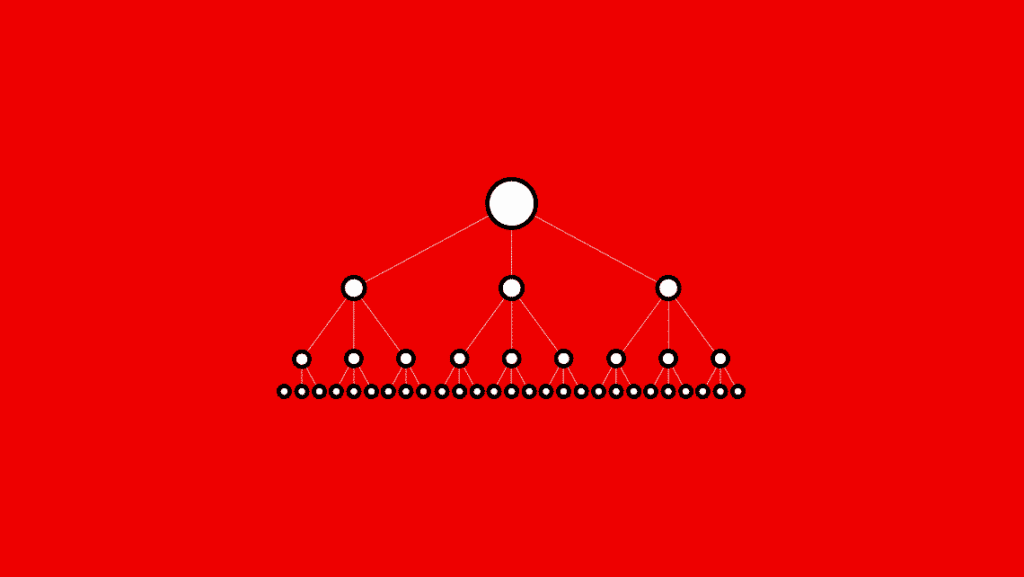
It's proven that when you follow a three-click structure, the results obtained with internal links are much better. And when we talk about three-click structure we're referring to users being able to reach the content with a maximum of three clicks from the HOME. Keep in mind that when a user needs more than three clicks to reach the content, the chances of frustration and also of abandoning the website increase.
Think about the anchor texts
The anchor texts you use will be key in delivering the expected results, that's why it's important to analyze them carefully to try to nail it. In fact, much of the success of internal linking will depend on getting the anchor text right.
For this, the most recommended is to do a complete keyword research that lets you know the keywords with the highest search volume, to apply them later in your strategy.
And a very useful tip is to use the largest number of internal links for those anchor texts that are most complicated to rank.
How many types of interlinking exist?
Now that we've seen the key points to consider when developing an interlinking strategy, let's analyze the different types of internal linking that exist. And to choose one of the three, we recommend you see your website as if it were the organizational chart of a small company, since this way it'll be easier to decide.
Horizontal internal linking
When preparing horizontal internal linking, you must keep in mind that in this type of linking there are no architecture levels. We could say that in horizontal interlinking there's no hierarchy, so all linked pages will be at the same level and will have the same authority. The HOME will be the only page that would stand out above the rest.
In horizontal linking, we would link different pages of the same category to each other, so we'd be making links between pages of the same level. The value of the pages could only vary according to the number of external links coming from other websites.
Vertical internal linking
In vertical internal linking we'll link to each other pages that don't have the same level of internal authority. Through this type of linking we'd focus a greater number of links to those pages or posts that have more complicated keywords to rank.
It's highly recommended that difficult-to-rank pages receive as many internal links as possible, since this way it'll be much easier to achieve their ranking in search engines.
Mixed internal linking
And finally there's the possibility of combining the two previous types of linking through a mixed internal linking strategy. For us, this is the most effective method. Why? Because it's characterized by taking the best of each of the previous linking methods.
The key to mixed internal linking is that it lets us give a higher value to a series of specific pages within the same structural level. We'll differentiate between those pages that receive a greater number of links due to their high difficulty for ranking, and between the pages that, due to being easy to rank, receive a smaller number of internal links.
Conclusion
In short, internal linking plays a fundamental role when ranking your web project and helping it take off, as long as you do it correctly. As we've mentioned, interlinking needs great planning, a lot of patience and a lot of common sense. Take note of the tips we've given you and don't hesitate to apply them when creating your internal linking strategy.
Related reading
- How to index your website on Google
- Ranking on Google: technique, content and authority
- Best SEO agency: real criteria
Shall we work together?
If you want to apply this in your company with a team that combines technical SEO, GEO and paid acquisition measured against the income statement, request a no-commitment audit. You can also check real case studies or read the public GEO baselines that Elevam Labs publishes every quarter.