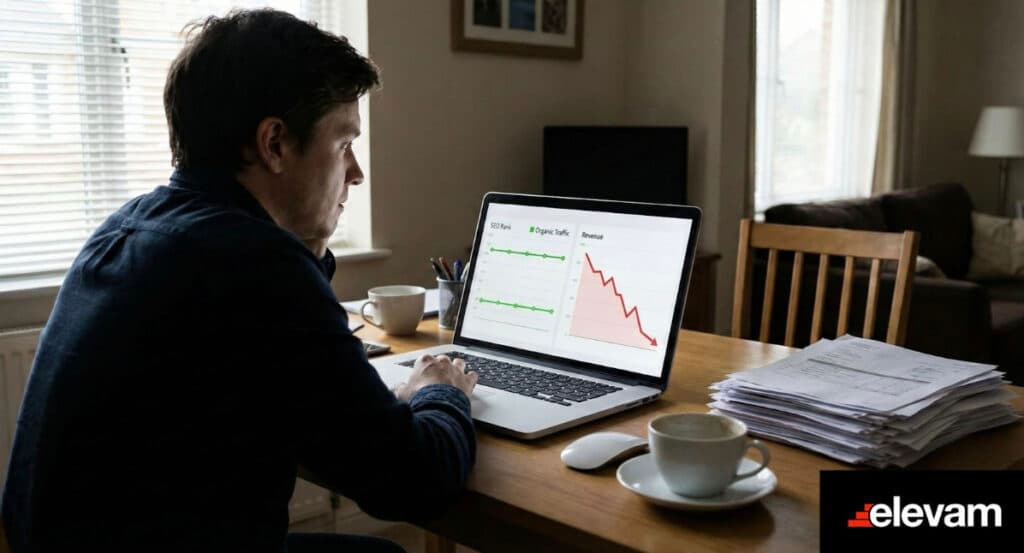
There's a type of drop you don't see in Search Console. It doesn't knock down positions, no core update "punishes" you, no dramatic curve to justify the scare. It's nastier: everything looks stable… and yet the business cools off.
It happens like this: your main keywords hold, traffic doesn't bleed and, suddenly, revenue falls. Not 2%. 10–15%. Enough to start doubting everything: pricing, seasonality, whether the sales team is softer, whether the market is "weird".
The explanation is usually simpler and more uncomfortable: the user no longer needs to enter your website to make the decision they used to make inside.
Before you were the restaurant. Today you're the ingredient supplier. AI cooks the dish, serves it in the interface, and the customer decides with that. If the dish is good, the user doesn't visit your kitchen. You become a commodity: you put in the raw material, you assume the cost of creating it, and the interface keeps the customer relationship. Even if the recipe carries your star ingredient, many times they don't even name you.
That's the new SEO conflict. It's not about "ranking". It's about being recommended.
**The real change isn't "SEO vs GEO".**It's "list of links" vs "answer layer"
In classic SEO you competed for a spot in a list.
In generative search you compete to be part of the final text: the fragment the model uses, the criterion it adopts, the source it cites (if it cites).
To understand it quickly, this table is usually enough:
| Aspect / Criterion | Classic SEO (deterministic) | Generative search (probabilistic) | |---|---|---| | What the user sees | List of links (10 blue links) | Direct answer + shortlist of sources | | What you compete for | Ranking position (1st, 2nd, 3rd…) | Presence and citation in the answer | | "Winning" unit | The URL / entire page | The fragment / idea / entity | | Metric that rules | CTR and sessions | Mentions, citations and share of presence | | Real risk | "Page 2" (invisibility) | Being absorbed (answer without click attribution) |
That last risk is new and lethal: your content can provide value and still return nothing to you.
How to know if you're suffering "silent erosion" (without making up theories)
When someone tells you "sales have dropped", the typical thing is to look at traffic and stop there. Wrong. Today you need to separate what's failing: visibility, decision or attribution.
| Symptom you see | What's usually happening | Type of problem | |---|---|---| | Stable positions + CTR dropping | The answer resolves in the SERP without need to click (zero-click). | Interface change / SERP Features | | Stable traffic + sales dropping | They compare and evaluate you "outside" your website (in AI chats or summaries). | Displaced decision (Dark Social/AI) | | Traffic drops little + leads drop a lot | Your brand appears less in AI direct recommendations or shortlists. | GEO problem (retrieval/citation) | | They "use" you but don't name you | The engine uses your information to generate the answer but doesn't attribute the source to you. | Attribution cannibalization / citability |
It doesn't help to discuss whether "Google is weird" if the problem is that the market decides on another layer.
Detecting this from inside is difficult because it requires breaking internal inertias. So, the most recommended thing is for an external specialized view to audit your real vulnerability before it gets worse. If you want it to be us, check our GEO service or our strategic consulting options.
Why your Top 1 doesn't translate into AI presence
We already explained it in our GEO course to appear in generative AI. Because in generative search you compete to be retrievable and be citable, not to "be the best SEO". If you lack either of the two, your #1 doesn't matter.
And in comparison sectors there's another element that decides above your ego: consensus.
The consensus factor: why being right alone is dangerous
AI seeks consensus to reduce risk.
If you confidently affirm something, but the rest of the ecosystem says something else (competitors, media, neutral sources, specialized forums), the model tends to choose the "safe" route. Not because you're wrong, but because the system reduces uncertainty: it prefers what it can back up with several coherent sources.
In GEO, being right alone is dangerous. If you're the only one who says X and the rest of the market says Y, AI treats you like a "potential hallucination" and hides you. Authority is no longer only vertical (what you know). It's also horizontal (what the market validates).
If your market lives on comparisons, ignoring consensus isn't a technical mistake. It's an unstoppable money leak.
The Citation Funnel: how it's decided whether you exist or not
This is the mental model we use to diagnose projects without self-deception:
Signals → Retrieval → Citation → Synthesis → Shortlist
-
Retrieval: do you enter as a candidate? (here SEO still matters).
-
Citation: do they attribute you when they use you? (here GEO is won or lost).
-
Shortlist: are you in the final 2–5? (if not, you don't exist).
Most companies only optimize "retrieval" and wonder why "AI doesn't recommend me". Because the engine isn't playing ranking: it's playing at building an answer with minimum risk and maximum perceived value.
What to do without turning your blog into a manual
The solution isn't to fill the post with bullets. AI buys that from you; the human reader abandons it.
The solution is this editorial rule: robot structure, human narrative.
Robot structure means your content has pieces easy to extract: a short definition, a clear comparison, a decision criterion, a conclusion that's understood without context. Few pieces, but surgical.
Human narrative means the article has tension: it presents the conflict, shows the cost, and lands a practical criterion. An entrepreneur doesn't want a class. They want to understand why their machine stops printing money.
How we work it in practice (without redoing everything)
Most make the mistake of starting with new content. We start with your pages that already have traction. Because there are already signals there. You just have to turn them into usable material.
You take your three strongest URLs. The ones that have always been "your pride" in SEO. And you make three movements.
First: you rewrite the beginning so the answer is at the top. Not a nice introduction. Answer and criterion.
Second: you turn the middle part into a comparison that can't be misinterpreted. In many sectors that's a table; in others it's an "if X happens, choose Y".
Third: you design a final sentence thinking it will be read without your logo next to it. It has to stand alone. It has to be able to stick inside an answer and remain true, clear and attributable.
That's response engineering. And yes: it hurts, because it forces you to stop writing for readers who scan and start structuring for robots that synthesize.
If you're holding rankings but the business falls, stop looking for the wrong culprits. It's not that SEO has died. It's that the place where it's decided has changed.
SEO is still the floor: without indexing and authority you don't enter the conversation. But GEO is what returns you to the shortlist. And in comparison markets, being out of that shortlist is being out of business.
If you want a quick diagnosis, don't send me your website. Send me three URLs that used to work and have now lost commercial performance. I'll tell you whether it's an SEO problem (technical / intent / conversion) or a GEO problem (retrieval / citability / consensus). And I'll tell you exactly where the leak is.
FAQs
What does "being retrievable" mean for a generative engine?
That your content consistently enters the set of candidate sources the system considers to build the answer. If you don't enter there, it can't choose you.
What does "being citable" mean?
That there's a self-contained block of yours (definition, criterion, comparison, conclusion) the system can use without dangerously rewriting it and, therefore, can attribute you without doubt.
Does this replace classic SEO?
No. SEO is the library (being catalogued). GEO is the librarian (being recommended). Without a library you don't exist, but being on the shelf no longer guarantees that anyone opens you.
Why does AI sometimes use my content but not cite me?
Because the synthesis mixes sources and prioritizes clarity and safety. If your information isn't easy to attribute (or there are "more citable" sources), it can absorb your idea and credit it to another… or to none.
What type of businesses suffer this "silent erosion" most?
The comparison ones: professional B2B, software, technical services, sectors decided by shortlist ("best X", "alternatives to Y", "comparison", "reviews").
Where do I start if I can only do one thing this month?
With your 3 strongest URLs. Not new content. If those pages go from "ranking" to "being used to answer", impact shows up sooner.
Why have we published this?
In recent months, at Elevam we've received a wave of clients with the same exact diagnosis: "My SEO metrics are green, but my revenue is red". They're not isolated cases; it's the new market standard.
We've written this article to save other experts and managers months of frustration. We've decided to synthesize our diagnostic methodology so the industry understands what's really happening.
We publish this because we believe the sector needs to stop looking for "algorithmic culprits" and start understanding the displacement of the decision. If this analysis helps you solve the puzzle without having to reinvent the wheel, we've fulfilled our goal. If you prefer that we apply the solution for you, you know where to find us.
Related reading
- How to expose data to AI with schema, feeds and entity
- Why AI doesn't recommend the same to everyone
- Elevam Labs public GEO baselines
Shall we work together?
If you want to apply this in your company with a team that combines technical SEO, GEO and paid acquisition measured against the income statement, request a no-commitment audit. You can also check real case studies or read the public GEO baselines that Elevam Labs publishes every quarter.